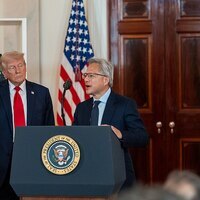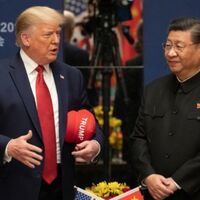


BEIJING, China: Artificial intelligence is expected to feature prominently in talks between U.S. President Donald Trump and Chinese President Xi Jinping this week, but analysts and officials say deep mistrust between the two countries makes major agreements unlikely.
The discussions come as competition over advanced AI systems intensifies, and both governments seek to reduce the risk of unintended escalation.
Two U.S. officials familiar with preparations said AI will be a key topic at the summit, marking the first time the technology has taken such a central role in talks between the two leaders.
Pressure for formal dialogue has increased following the release of Anthropic's powerful Mythos model, which analysts say has heightened concerns about cybersecurity and the strategic implications of increasingly capable AI systems.
China was excluded from early access to the model, raising concerns in Beijing that the technology could be used to identify vulnerabilities in Chinese software and financial systems.
Chinese officials have proposed a formal AI dialogue led by U.S. Treasury Secretary Scott Bessent and Chinese Vice Finance Minister Liao Min, according to a source briefed on the outreach.
White House officials said advanced AI systems have made a "channel of communication" with China essential.
Researchers have warned that increasingly powerful models could accelerate cyberattacks, disinformation campaigns, biological threats, and financial disruptions.
Both countries may consider practical confidence-building measures, such as a hotline to report suspected AI-related incidents.
"Getting senior Western figures to engage directly with China (on AI) has become increasingly difficult, though a positive signal from the Xi-Trump summit could change that," said Kwan Yee Ng, head of international AI governance at Beijing-based AI safety consultancy Concordia AI.
Other analysts have proposed guardrails for frontier AI systems and commitments to reduce AI-enabled malicious activity.
"China likely hopes the U.S. will appropriately distinguish between AI governance and technological containment," said Sun Chenghao of Tsinghua University, who has participated in U.S.-China unofficial Track II AI talks.
However, tensions remain high as U.S. lawmakers consider additional restrictions on China's access to semiconductor supply chains.
"This is a really crucial window for Beijing to act and try to get the U.S. to commit to shutting it down," said Reva Goujon, geopolitical strategist at Rhodium Group.
"When one side sees AI as a proliferation risk to be contained and the other sees containment as an attack on a general-purpose technology, that makes it really difficult to find common ground," Ng said.